

How to Minimize Conflict During Child Arrangement Discussions: A Guide for Families in Steep, HAM
Separation is, by its nature, a deeply emotional and challenging time. When children are involved, those emotions become intensely amplified, often leading to arguments over routines, schedules, and who “deserves” what-discussions that can feel endless, exhausting, and frankly, overwhelming. If you are grappling with the prospect of co-parenting after separating from your partner in a close community like Steep, HAM, it is natural to feel immense stress about how these major decisions will affect your family’s stability in all our service areas.
The goal here is not merely to sign papers; the true objective-the core signature perspective we focus on-is building a functional blueprint for life. This means creating a plan that supports every member of the household, allowing you all to move forward with mutual respect and predictability. Minimizing conflict during child arrangement discussions isn't about pretending emotions don't exist; it is about learning structured techniques and adopting processes designed specifically to channel those strong feelings into productive outcomes.
When High Emotions Cloud Necessary Decisions: A Local Approach to Co-Parenting
Making major decisions regarding your children while living in a tight-knit community like Steep, HAM, adds an extra layer of pressure that can feel isolating. Every conversation seems weighted with personal history and local expectations, making it incredibly difficult to focus purely on the child's needs. It is crucial first to acknowledge that conflict often feels rooted not in a lack of love for your children-far from it-but rather in differing expectations and communication breakdowns regarding practical routines and boundaries.
The challenge many families face is the tendency to let grievances about past behavior overshadow current logistical needs (like who drives where, or what happens on school holidays). This shifts the conversation from "What schedule supports little Leo's academic routine?" to "You always failed at things." We must make a deliberate shift in focus. Instead of asking ourselves who 'wins' the discussion, we need to ask: "What does our child need right now to thrive?"
This requires understanding that minimizing conflict is not something you can simply wish away or willpower your way through; it is a skill learned through structured dialogue. By adopting a method like mediation, you are essentially receiving training in constructive communication-a vital life skill for any co-parenting unit. We help families across Steep and the surrounding South Downs region transition from emotional battles to collaborative problem-solving.
Beyond Litigation: Understanding Why Conflict Escalates and How Mediation Intervenes
The default assumption many people make when facing separation is that the only recourse is formal court proceedings. While legal action certainly has outcomes, it’s vital to understand the mechanics of high-conflict disputes, particularly how they escalate conflict rather than resolving it.
Conflict escalates when parties focus relentlessly on blame rather than solutions. Discussions become cyclical, repeating past grievances-"Remember when you…" or "You always used to…"-which serves only to drain emotional energy and build resentment, rather than creating a viable schedule for the next year.
This brings us to addressing the most common objection: "My solicitor says we must go to court." While it is true that solicitors are experts in legal frameworks, their role is often geared toward protecting rights and positions, which inherently requires an adversarial approach. Litigation, by nature, forces two sides into opposition; it is expensive, time-consuming, and fundamentally shifts the focus from the child's best interest to whose position is legally stronger.
Mediation changes this entire dynamic. It is a confidential, neutral process where neither party yields control of the final outcome to an external judge or legal authority. Instead, both parties retain ownership and agency over the agreement reached. Specialized Child Arrangement Mediation provides what we call a structured container for difficult conversations. This structure ensures that even when emotions are high, the dialogue remains focused on practical schedules-the logistical realities of pick-up/drop-off points in Midhurst, managing school routines across Hindhead, or coordinating handover during holidays in Shalford.
"The goal of mediation is not to determine who was right or wrong in the past, but to build a practical and stable agreement for the future."
Practical Steps: A Guide to Minimizing Conflict During Child Arrangements Discussions
Feeling lost on how to start these difficult discussions can be the biggest barrier. To overcome this anxiety, it helps to visualize the process as a clear journey with defined steps. Understanding the co-parenting agreement mediation process demystifies what lies ahead and significantly reduces the fear of complexity.
The process generally follows three stages: Preparation $
ightarrow$ Mediation Meeting $
ightarrow$ Drafting Agreement.
1. Pre-Mediation Preparation: Building Your Foundation
Before you even step into the meeting room, preparation is key. We guide families through listing needs versus wants. For instance, a need might be "the child must attend their current school." A want might be "I wish we could move to a different area." By separating these, you identify non-negotiables (things that absolutely must be in the plan) from flexible points (areas where compromise is possible). This structured approach helps depersonalize the arguments.
2. During Mediation: De-escalation Techniques
During the actual meeting, the mediator acts as a skilled guide to de-escalate tension. Techniques are employed to keep the conversation functional. These might include designated "time-outs" when emotions become overwhelming, or using joint interest statements. Instead of accusing ("You never help with school runs"), the focus shifts to the shared concern: "What does little Tom need regarding reliable transport between his lessons and home?" This reframing immediately moves the conversation into problem-solving mode. An anecdote I recall working on involved a dispute over pet ownership; by shifting the language from 'my property' to 'how will this dog benefit the child’s emotional well-being?'-the conflict dissolved almost instantly, replaced by mutual care.
3. The Measurable Outcome: Your Parenting Plan
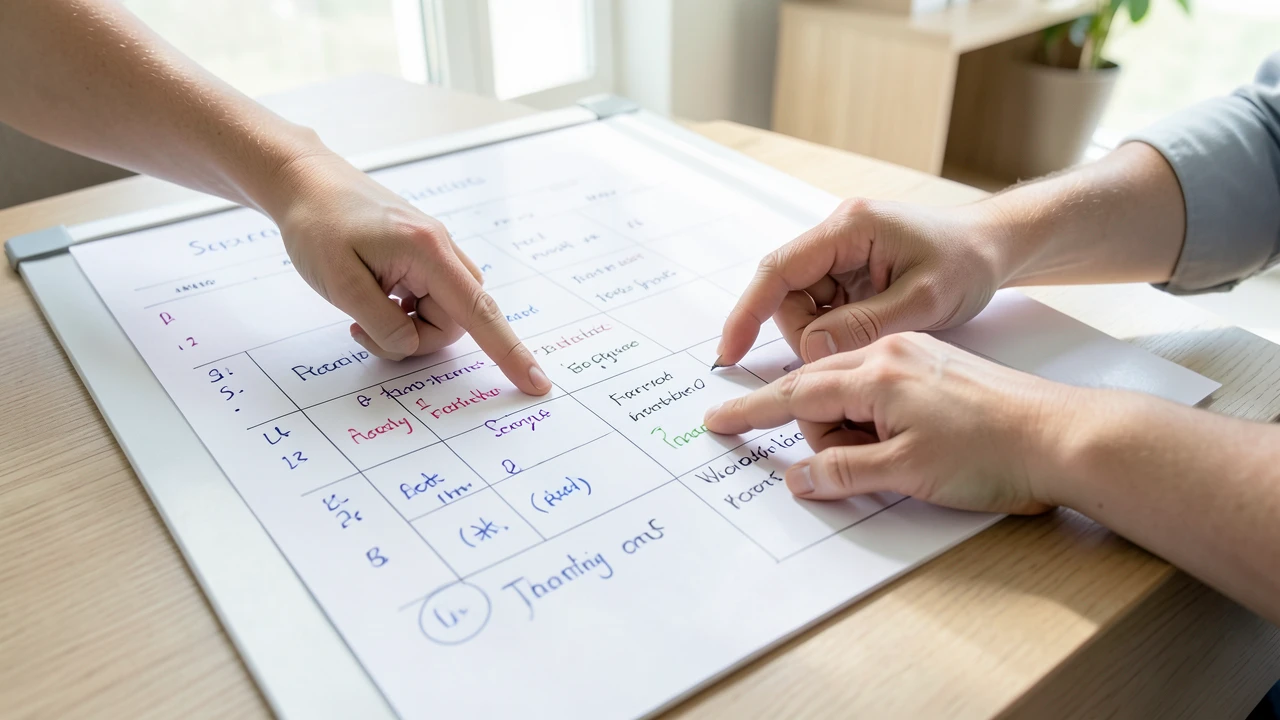
The goal is not just an agreement on dates, but a detailed parenting plan mediation South Downs blueprint. This plan must cover logistics (who drives whom when), communication protocols (e.g., using a specific shared calendar app for scheduling), and holiday rotations. It turns abstract feelings into concrete actions that are easy to follow day-to-day.
Building Future Stability: Agreements That Work for Life in the South Downs
One of the most frequent lingering concerns after mediation is enforceability: "If we agree today, what happens if one of us changes our mind next year?" This concern about stability and legal permanence is completely valid, and it’s important to address it head-on.
A mediated agreement, when properly drafted by experienced professionals like those at Hants Family Mediation, is not simply a suggestion; it is a legally binding document. While the process itself is private, that final agreement can be formalized through court processes if necessary, giving it the weight and enforceability required for long-term family stability.
We frame this outcome not as 'divorce,' but as establishing a sustainable post-separation family unit. Our commitment goes beyond just scheduling; we help integrate these child arrangements with other areas of separation-such as financial division or property settlement-to create one single, cohesive plan that provides true future security for everyone involved. Our approach is profoundly local: it is tailored to the rhythm of life in Midhurst, Hindhead, or Shalford. We understand the unique community connections and the importance of discretion when making these sensitive decisions here in the South Downs.
Taking the First Step Towards Clarity and Peace
I know that initiating this conversation feels like facing a deeply difficult challenge, perhaps even more daunting than confronting the legal system itself. However, remember that taking the first step is often the hardest part, but it is also the most powerful one.
If you are struggling with communication or feel overwhelmed by the thought of endless disputes, please know that professional guidance is available to help guide you back toward clarity and peace. Our process emphasizes discretion; whether through a virtual meeting or a discreet local session near Steep, we manage the complexity while respecting your privacy.
We are here specifically because conflict-the kind that drains resources, time, and emotional health-is avoidable. If the thought of court is draining your financial or mental resources, exploring child custody mediation Steep HAM is the most measured, compassionate first step you can take. We provide the structure, the neutral ground, and the expertise to help you build a functional blueprint that works for life.
The path toward co-parenting peace requires patience, communication, and the right tools. Don't wait until conflict reaches its peak; reach out today to discuss how non-adversarial separation methods can restore stability to your family unit. our full range of services. our team.